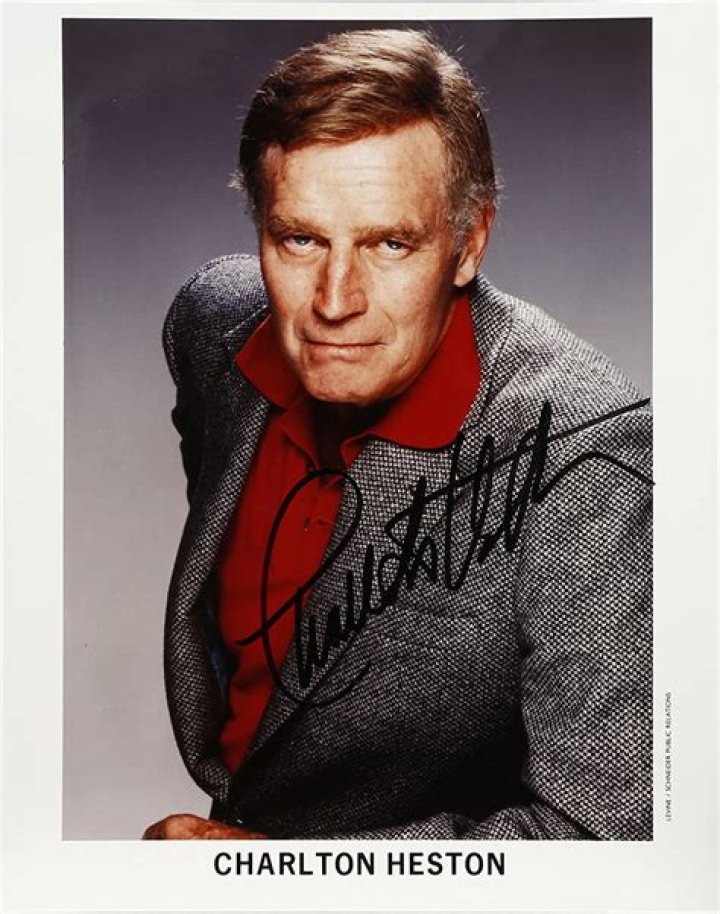
Known for movies
Short Info
| Net Worth | $40 million |
| Date Of Birth | October 4, 1923 |
| Died | April 5, 2008, Beverly Hills, California, United States |
| Spouse | Lydia Clarke |
| Mark | His deep, commanding voice |
| Fact | Neighbors who live down the hill from Heston filed a lawsuit against the actor, alleging their property was damaged in January 2005 when heavy rain sent hillside debris pouring into their home. The lawsuit alleges that “slope failure” on Heston’s property caused substantial damage to their home, diminishing the market value of their property. The couple seek at least $1.2 million, as well as punitive damages. Jeff Briggs, Heston’s attorney, said the actor owns ten per cent of the hillside, while the neighbors own the rest. (3 January 2007). |
| Payments | Earned $50,000 from The Greatest Show on Earth (1952) |
Charlton Heston was an American actor and activist born on 4 October 1923 in Wilmette, Illinois USA. He’s known for starring in blockbuster movies such as “The Ten Commandments” and “Ben-Hur”.
Early Life
John Charles Carter was the oldest child of Lilla Charlton and Russel Whitford Carter, of English and Scottish descent. It’s known his ancestors arrived in North America in early 1600s.
Despite being born in Illinois, John Charles actually grew up in Michigan, where his family moved to when he was a child due to his father’s work. In his new home in St. Helen, John grew up in an isolated, rural environment along with his two younger siblings Lilla and Alan, until their parents’ divorce in 1933.
Shortly after their mother’s second marriage to Chester Heston, the kids moved back to their hometown in Illinois, and the kids adopted their stepfather’s surname.
Though it’s certain Heston’s first name was John Charles at the time of his birth, his name was changed sometime during his childhood, as records of 1930 show he was Charlton J. Carter at the age of six – “Charlton” was originally Heston’s grandmother Marian’s maiden name. After she divorced her first husband Charles Baines, she married again to William Henry Lawton and made her children–including Lilla- adopt the surname to distance them from their father.
Regarding his faith, Heston was born in an Episcopalian family and considered himself as one for the rest of his life. He often emphasized his enjoyment of the aspects of Christian’s faith.
Although there’s no information about Heston’s primary education, it known that he attended New Trier High School, as he recalled in his autobiography “The Actor’s Life” of 1976: ‘All kids play pretend games, but I did it more than most. Even when we moved to Chicago, I was more or less a loner. We lived in a North Shore suburb, where I was a skinny hick from the woods, and all the other kids seemed to be rich and know about girls.’
Not only did he become an avid tennis player during his high school years, he also developed an interest in acting after participating in a teen play. Ultimately, this interest led him to obtain a drama scholarship to attend Northwestern University.
In college Heston had his first acting experience in the amateur film “Peer Gynt” by David Bradley. He also found a side job as a model, which helped to provide for himself during his student years.
Career
Military
Charlton Heston enlisted in US Army Air Force in 1944, during World War II. He served in the Alaskan Aleutian Islands as an aerial gunner, piloting a Mitchell B-25. During his time with the Eleventh Air Force Squadron, Heston was promoted to Sergeant rank.
Acting
After the war ended, Heston moved to New York searching for job opportunities as actor. It didn’t take him long to be cast in “Antony and Cleopatra” on Broadway, which led him to gain real experience in the entertainment industry.
Heston spent some time living in New York, but in 1949 he moved to Los Angeles and landed a small role in the TV series “Suspense”, and then played various characters in “Studio One”. He was cast as Marc Antony in the 1950s movie “Julius Caesar”, followed by his first starring role in “Dark City”, directed by William Dieterle. Although those productions were relatively modest and he had not become famous yet, he left a good impression on the iconic director Cecil B. DeMille who had watched his performance, and offered him a role in “The Greatest Show on Earth” as a circus manager.
This was considerably fortunate for Heston’s career, who received good critiques regarding his acting, and the film ultimately won an Oscar for Best Picture in 1952.
Heston then appeared in “The President’s Lady” in 1953, which was not only his first important starring role but also became the first historical movie of his career. The next three years Heston acted in a variety of productions, including the TV series’ “Medallion Theatre” and “Danger”.
Heston then starred in various movies such as “Bad for Each Other”, “The Naked Jungle” and “Secret of the Incas”, a string of leading roles that led him to land one of the most important works of his career, and the character for which he would be remembered for years to come, as Moses in Cecil B. DeMille’s epic drama “The Ten Commandments”, premiered in 1956.
By this time and less than ten years into his career, Heston had become one of the most praised actors of his generation, and his rise in fame was unstoppable. His next roles were just as good, as he had the opportunity to work with several big names in the industry, such as director of the “Touch of Evil”, Orson Welles.
In 1959 Heston won his first Academy Award for Best Actor for his starring role in the highly acclaimed “Ben-Hur” by William Wyler. This role also reaffirmed his place as Hollywood’s favorite actor for historical roles.
Although “Ben-Hur” was retrospectively Heston’s career peak, he subsequently appeared in a variety of movies, which include “El Cid” in 1961, “55 Days at Peking” in 1963, “The Agony and the Ecstasy” and “The Greatest Story Ever Told” in 1965.
Despite his success playing historical characters, westerns remained Charlton Heston’s favorite movie genre, and fortunately for him he had the opportunity to act in movies of that type such as “Will Penny”.
“Planet of the Apes” was Heston’s first incursion into Sci-Fi, followed by a minor appearance in its sequel. He also appeared in “The Omega Man” and “Soylent Green”, and by the end of his career, his acting repertoire included almost one hundred movies.
Political Activism
Liberal
Even before participating in political issues, Heston was regarded as an important figure for Americans: ‘(he) is the epitome of the star who stands for moral certainties and patriotic beliefs that characterized Hollywood in its heyday’.
In 1955 Heston started being open about his political views, and publicly supported Democrat candidates. In 1964 he participated in the Civil Rights Act movement and from 1966 to 1971 he was president of the Screen Actors Guild (SAG), even endorsing gun control policies.
Conservative
However, Heston’s political views took a conservative change and he officially became a Republican Party supporter in 1972. Following an interview in 1987 by Reason, he declared what caused this decision: ‘I think the Democratic Party has moved sharply to the left in the last 20 years. If you read the inaugural address Jack Kennedy gave, you’ll realize he could not possibly have given it on the platform the Democrats concocted at the last convention in San Francisco.’
From then on, Heston’s constantly expressed his conservative views to the public, and openly showed his support for Ronald Reagan. He also opposed the Vietnam War, pro-abortion laws and changed his mind about gun control, becoming National Rifle Association’s president in 1998.
He fervently opposed to Bill Clinton: ‘America doesn’t trust you with our 21-year-old daughters, and we sure, Lord, don’t trust you with our guns’.
Personal Life
During his time studying at Northwestern University, Heston met fellow student Lydia Marie Clarke, who he married in 1944. The couple had a son together named Frank, and subsequently adopted a girl named Holly.
Health and Death
Although in his youth Heston enjoyed good physical condition, he faced various problems with his health during the last decade of his life. In 1996 Heston had hip replacement surgery, and in 1998 he was diagnosed with prostate cancer, which he survived after a long treatment.
In 2002 Heston publicly announced that he was presenting symptoms of Alzheimer’s disease. In his passionate statement, he expressed a deep honesty to his audience and friends about his condition: ‘If you see a little less spring to my step, if your name fails to leap to my lips, you’ll know why. And if I tell you a funny story for the second time, please laugh anyway’.
Charlton Heston died on 5 April 2008 at the age of 85, after suffering from pneumonia.
Net Worth
As a result of his long career as a Hollywood actor, Charlton Heston had an estimated net worth of $40 million.
Physical Appearance
Regarded as a handsome man, Charlton Heston had a chiseled jaw, blond hair and an enigmatic voice. His weight was unknown; his height was 6ft 3ins (1.90m).
Interesting Facts
His wife Lydia was also an actress; she died in 2018.
Heston acted alongside his brother Alan in “Peer Gynt”.
Charlton Heston’s childhood nickname was “Chuck”, and even in his adulthood he was called that by his friends. However, his wife always called him Charlie.
He played Marc Antony’s character two times in his career.
He marched alongside Martin Luther King in 1963.
His childhood hobbies were fishing and hunting.
General Info
| Full Name | Charlton Heston |
| Net Worth | $40 million |
| Date Of Birth | October 4, 1923 |
| Died | April 5, 2008, Beverly Hills, California, United States |
| Height | 1.91 m |
| Profession | Voice Actor, Film director, Political activist |
| Education | New Trier High School, Northwestern University |
| Nationality | American |
Family
| Spouse | Lydia Clarke |
| Children | Fraser Clarke Heston, Holly Ann Heston |
| Parents | Lilla Carter, Russell Whitford Carter |
Accomplishments
| Awards | Academy Award for Best Actor, Presidential Medal of Freedom, Kennedy Center Honors, Golden Globe Cecil B. DeMille Award, Jean Hersholt Humanitarian Award, Screen Actors Guild Life Achievement Award, Golden Globe Henrietta Award for World Film Favorites, David di Donatello for Best Foreign Actor |
| Nominations | Golden Globe Award for Best Actor – Motion Picture – Drama, Golden Globe Award for Best Actor – Motion Picture Musical or Comedy, Primetime Emmy Award for Outstanding Informational Special, MTV Movie Award for Best Cameo, Primetime Emmy Award for Best Actor |
| Movies | Ben-Hur, The Ten Commandments, Planet of the Apes, Soylent Green, The Omega Man, Touch of Evil, El Cid, Will Penny, The Agony and the Ecstasy, The Greatest Show on Earth, The Big Country, 55 Days at Peking, Beneath the Planet of the Apes, The Greatest Story Ever Told, The President’s Lady, Khartoum,… |
| TV Shows | The Colbys, Chiefs, Eco-Challenge, America 2-Night, F.D.R. |
Social profile links
| IMDB |
Marks
| # | Marks / Signs |
|---|---|
| 1 | Lean yet muscular physique |
| 2 | Frequently played heroic or larger-than-life characters |
| 3 | Roles in biblical epics (The Ten Commandments (1956), Ben-Hur (1959), and The Greatest Story Ever Told (1965)) |
| 4 | His deep, commanding voice |
Salary
| Title | Salary |
|---|---|
| The Colbys (1985) | $90,000 per episode |
| Julius Caesar (1970) | $100,000 + 15% of the gross |
| The Buccaneer (1958) | $250,000 |
| Touch of Evil (1958) | 7.5% of the gross |
| The Greatest Show on Earth (1952) | $50,000 |
| Julius Caesar (1950) | $50 /week |
Quotes
| # | Quote |
|---|---|
| 1 | Orson really understood the process. I remember we were looking at dailies one day and he leaned over and said, ‘You know, Chuck, you have to work on your tenor range. Those of us with great bass voices love to rumble along in them. The tenor range is a knife edge; the bass is a velvet hammer. You have to use them both’. That was very useful. I’d never thought of it before. |
| 2 | Orson [Welles] insists he hates acting but of course he is a very good actor and is really able to communicate with actors. It’s not too often that you learn about acting from directors because that isn’t what they do. They sometimes make you act better, but to really understand the process is a different thing. |
| 3 | A lot of men in positions of authority are difficult people, because they’re right, and they know they’re right. |
| 4 | [September 2002] I’ve always been sure of my health and this suddenly gave me something else to think about. But maybe it’s good if God gives you something to think about every so often. Whatever happens happens. You take it in stride if you can. You don’t have many options there. |
| 5 | [on actors advocating their political opinions]: Well, we have as much right to shoot our mouths off as anyone else. God knows I’ve exercised that right. |
| 6 | Why does Cary Grant get all those pictures set entirely in penthouses? |
| 7 | I’ve almost never been content with what I’ve done in any film. My heart’s desire would be to do them all over again – and not do a half dozen of them at all. |
| 8 | I’d rather play a senator than be one. |
| 9 | [on his role in The Ten Commandments (1956)] I was a little green in the film. I could do it better now. |
| 10 | I like playing great men. They’re more interesting than the rest of us. |
| 11 | [on how his marriage lasted as long as it did]: Remember three simple words – I was wrong. |
| 12 | I have lived such a wonderful life! I’ve lived enough for two people. |
| 13 | I have a face that belongs in another century. |
| 14 | [on Richard Harris] He’s something of a fuck-up, no question. |
| 15 | [on Richard Harris] Richard is very much the professional Irishman. I found him a somewhat erratic personality and an occasional pain in the posterior. But we certainly never feuded. |
| 16 | [on Anne Baxter] We never had a cross word. However, I did not find her enormously warming and there was no great personal stirring between us as friends. |
| 17 | [on working with Ava Gardner in 55 Days at Peking (1963)] Today marked the worst behavior I’ve yet seen from that curious breed I make my living opposite. Ava showed up for a late call, did one shot (with the usual incredible delay in coming to the set), and then walked off just before lunch when some Chinese extra took a still of her. She came back after a painful three-hour lunch break only to walk off, for the same reason. |
| 18 | [on Sophia Loren] All in all the most trying work time with an actress I can ever recall. Mind you, she’s not a bitch. She’s a warm lady, truly; she’s just more star than pro. |
| 19 | [on Orson Welles] He was not an extravagant director. I mean, Warren Beatty can spend $60 million making Reds (1981) a half-hour too long and it crosses nobody’s lips that that’s too much money. |
| 20 | I have spent my life in service to these two sacred sets of work – the gift of human passion in William Shakespeare and the gift of human freedom enshrined in the American bill of human rights. Tony Blair can have his bodyguards and the police are all allowed to defend themselves, then so should the people. |
| 21 | [1998] The law-abiding citizen is entitled to own a rifle, pistol, or shotgun. The right, put simply, shall not be infringed. |
| 22 | [2000] Al Gore is now saying, “I’m with you guys on guns”. In any other time or place you’d be looking for a lynching mob. |
| 23 | Somebody once approached Kirk Douglas and said they had enjoyed his performance in Ben-Hur (1959). So he said, ‘That wasn’t me, that was another fellow.’ And the man said, ‘Well, if you aren’t Burt Lancaster, who the hell are you?’ |
| 24 | [2000] Vote freedom first. Vote George W. Bush. Everything else is a distant and forgettable second place. This is the most important election since the Civil War. Al Gore, if elected, would have the power to hammer your gun rights right into oblivion. Instead of fighting redcoats, we are now fighting blue blood elitists. |
| 25 | [Following the death of Gregory Peck in 2003] Gregory Peck was one of those few great actors of generosity, humor, toughness and spirit. From our fight scene in The Big Country (1958) to his willingness to stand up for what he believed personally, Gregory Peck faced life’s challenges with great vigor and courage. |
| 26 | I have never felt I was being ill-treated by the press – ill-treated by Barbra Streisand, maybe. But Ms. Streisand I suggest is inadequately educated on the Constitution of the United States. |
| 27 | [August 9, 2002] My Dear Friends, Colleagues and Fans: My physicians have recently told me I may have a neurological disorder whose symptoms are consistent with Alzheimer’s disease. So . . . I wanted to prepare a few words for you now, because when the time comes, I may not be able to. I’ve lived my whole life on the stage and screen before you. I’ve found purpose and meaning in your response. For an actor there’s no greater loss than the loss of his audience. I can part the Red Sea, but I can’t part with you, which is why I won’t exclude you from this stage in my life. For now, I’m not changing anything. I’ll insist on work when I can; the doctors will insist on rest when I must. If you see a little less spring in my step, if your name fails to leap to my lips, you’ll know why. And if I tell you a funny story for the second time, please laugh anyway. I’m neither giving up nor giving in. I believe I’m still the fighter that Dr. [Martin Luther King] and [John F. Kennedy] and Ronald Reagan knew, but it’s a fight I must someday call a draw. I must reconcile courage and surrender in equal measure. Please feel no sympathy for me. I don’t. I just may be a little less accessible to you, despite my wishes. I also want you to know that I’m grateful beyond measure. My life has been blessed with good fortune. I’m grateful that I was born in America, that cradle of freedom and opportunity, where a kid from the Michigan Northwoods can work hard and make something of his life. I’m grateful for the gift of the greatest words ever written, that let me share with you the infinite scope of the human experience. As an actor, I’m thankful that I’ve lived not one life, but many. Above all, I’m proud of my family … my wife Lydia, the queen of my heart, my children, Fraser and Holly, and my beloved grandchildren, Jack, Ridley and Charlie. They’re my biggest fans, my toughest critics and my proudest achievement. Through them, I can touch immortality. Finally, I’m confident about the future of America. I believe in you. I know that the future of our country, our culture and our children is in good hands. I know you will continue to meet adversity with strength and resilience, as our ancestors did, and come through with flying colors – the ones on Old Glory. William Shakespeare, at the end of his career, wrote his farewell through the words of Prospero, in “The Tempest”. It ends like this: “Be cheerful, sir. Our revels now are ended. These our actors, as I foretold you, were all spirits and are melted into air, into thin air: And, like the baseless fabric of this vision, the cloud-cap’d towers, the gorgeous palaces, the solemn temples, the great globe itself, yea all which it inherit, shall dissolve and, like this insubstantial pageant faded, leave not a rack behind. We are such stuff as dreams are made on, and our little life is rounded with a sleep”. Thank you, and God bless you, everyone. |
| 28 | “Hard” is what I do best. I don’t do “nice”. |
| 29 | Jackson was one of my favorite Presidents. One mean son of a bitch. |
| 30 | Too many gun owners think we’ve wandered to some fringe of American life and left them behind. |
| 31 | I’m pissed off when Indians say they’re Native Americans! I’m a Native American, for chrisakes! |
| 32 | [on President Bill Clinton] America didn’t trust you with their health-care system, America didn’t trust you with gays in the military, America doesn’t trust you with our 21-year-old daughters. And we sure, Lord, don’t trust you with our guns. |
| 33 | [explaining his endorsement of the Gun Control Act of 1968] I was young and foolish. |
| 34 | I didn’t change. The Democratic Party slid to the Left from right under me. |
| 35 | Once the 1964 Civil Rights Act passed, I had other agendas. |
| 36 | Somewhere in the busy pipeline of public funding is sure to be a demand from a disabled lesbian on welfare that the Metropolitan Opera stage her rap version of “Carmen” as translated into Ebonics. |
| 37 | In Hollywood there are more gun owners in the closet than homosexuals. |
| 38 | In the beginning an actor impresses us with his looks, later his voice enchants us. Over the years, his performances enthrall us. But in the end, it is simply what he is. |
| 39 | People in the film community think being politically active means getting on Air Force One and going to dinner at the White House. I’ve scorned a few liberals in this town, and I get a kick out of that. |
| 40 | The Constitution was handed down to guide us by a bunch of those wise old, dead, white guys who invented this country. It’s true – they were white guys. So were most of the guys who died in [Abraham Lincoln]’s name, opposing slavery in the 1860s. So, why should I be ashamed of white guys? Why is Hispanic pride or black pride a good thing, while white pride conjures up shaved heads and white hoods? |
| 41 | Mainstream America is depending on you – counting on you – to draw your sword and fight for them. These people have precious little time or resources to battle misguided Cinderella attitudes, the fringe propaganda of the homosexual coalition, the feminists who preach that it’s a divine duty for women to hate men, blacks who raise a militant fist with one hand, while they seek preference with the other. |
| 42 | I find my blood pressure rising when [Bill Clinton]’s cultural shock troops participate in homosexual rights fund raisers but boycott gun rights fund raisers – and then claim it’s time to place homosexual men in tents with Boy Scouts and suggest that sperm-donor babies born into lesbian relationships are somehow better served. |
| 43 | People don’t perceive me as a shy man. But I am. I am thought of mostly in terms of the parts I play. I am seen as a forbidding authority figure. I only wish I were as indomitable as everyone thinks. |
| 44 | It’s been quite a ride. I loved every minute of it. |
| 45 | [1999] I marched for civil rights with Dr. [Martin Luther King] in 1963 – long before Hollywood found it fashionable. But when I told an audience last year that white pride is just as valid as black pride or red pride or anyone else’s pride, they called me a racist. I’ve worked with brilliantly talented homosexuals all my life. But when I told an audience that gay rights should extend no further than your rights or my rights, I was called a homophobe. I served in World War II against the Axis powers. But during a speech, when I drew an analogy between singling out innocent Jews and singling out innocent gun owners, I was called an anti-Semite. Everyone I know knows I would never raise a closed fist against my country. But when I asked an audience to oppose this cultural persecution, I was compared to Timothy McVeigh. |
| 46 | You can spend a lifetime, and, if you’re honest with yourself, never once was your work perfect. |
| 47 | The big studio era is from the coming of sound until 1950, until I came in … I came in at a crux in film, which was the end of the studio era and the rise of filmmaking. |
| 48 | [on Pulp Fiction (1994)] Now what [Quentin Tarantino will say to that is, “Don’t you understand? This is a black comedy. We’re holding this up to ridicule”. There’s no worse thing you can accuse a cool person of being than not getting a joke. |
| 49 | In recent years, anyone in the government, certainly anyone in the FBI or the CIA, or recently, in again, [Clint Eastwood]’s film, In the Line of Fire (1993), the main bad guy is the chief advisor to the president. |
| 50 | [on The Greatest Story Ever Told (1965)] There are actors who can do period roles, and actors who can’t . . . God knows, [John Wayne] couldn’t play a first-century Roman! |
| 51 | It is not widely known that one of the finest gun collections on the West Coast is Steven Spielberg’s. He shoots, but very privately. |
| 52 | Warren Beatty is non-typical of Hollywood liberals. He thinks [Bill Clinton] is an idiot. |
| 53 | Most people in the film community don’t really understand what being politically active means. They think it is just doing interviews. I’m content that the Hollywood left thinks being a political activist means riding Air Force One and hanging out with the President. |
| 54 | The great roles are always Shakespearean. |
| 55 | It is essential that gun owners unite in an active, growing force capable of flexing great muscle as the next millennium commences. |
| 56 | It’s hard living up to Moses. |
| 57 | [following the death of Barbara Stanwyck in 1990] She was a great broad, in all the meaning of the word. |
| 58 | [following the death of Gary Cooper in 1961] He was a wonderful, forthright and honorable man. |
| 59 | I can’t remember a time when I didn’t want to be an actor. |
| 60 | I’ve been killed often, on film, the stage, and the television tube. Studios insist the audience doesn’t like this. It’s been my experience that it makes them unhappy, but that’s not the same thing. In any event, they often attend those undertakings where I come to a violent end even more enthusiastically than they do those where I survive. There may be a message for me somewhere there. |
| 61 | I have played three presidents, three saints and two geniuses. If that doesn’t create an ego problem, nothing does. |
| 62 | The minute you feel you have given a faultless performance is the time to get out. |
| 63 | [after completing El Cid (1961)] After spending all of last winter in armor it’s a great relief to wear costume that bends. |
| 64 | If you can’t make a career out of two de Milles, you’ll never do it. |
| 65 | There’s a special excitement in playing a man who made a hole in history large enough to be remembered centuries after he died. |
| 66 | [talking about what he sees as Hollywood’s stereotyping of Protestant religious figures] Clergymen tend to be unreliable and pompous figures. Seldom Jewish rabbis, less often Catholic priests, but Protestant ministers tend to be . . . not really very admirable. Not necessarily evil, but silly. And wrong, of course. |
| 67 | [message sent to US troops in Iraq, 2003] There is no duty more noble than that which has called you across the world in defense of freedom. Yours is a mission of hope and humanity for the oppressed. Rest assured that while pretend-patriots talk of supporting you, even as they condemn your noble cause, an unwavering vast majority of Americans share and take pride in your mission. You represent all that is good and right about America and are the true face of American patriotism. You walk in those same righteous footsteps of all those patriots who, before you, fought to preserve liberty for all. Our prayers and our personal gratitude are with you and your families. May God Bless You, Charlton and Lydia Heston/. |
| 68 | I don’t know the man – never met him, never even spoken to him. But I feel sorry for George Clooney – one day he may get Alzheimer’s disease. I served my country in World War II. I survived that – I guess I can survive some bad words from this fellow. |
| 69 | Here’s my credo. There are no good guns, There are no bad guns. A gun in the hands of a bad man is a bad thing. Any gun in the hands of a good man is no threat to anyone, except bad people. |
| 70 | People have been asking me for thirty-five years if I was losing jobs because of my conservative politics. I’ve never felt that was the case. |
| 71 | [on Robert De Niro] It’s ridiculous for an actor that good to keep playing Las Vegas hoods. |
| 72 | I’ve played cardinals and cowboys, kings and quarterbacks, presidents and painters, cops and con-men. |
| 73 | [from his final televised interview in December 2002, regarding his recent diagnosis of Alzheimer’s disease] What cannot be cured must be endured. |
| 74 | The Internet is for lonely people. People should live. |
| 75 | Political correctness is tyranny with manners. |
| 76 | [on conquering his alcohol addiction in 2000] It was one of my best recent years. And now I’m not drinking at all. I wasn’t slurring my words. I wasn’t falling over, but I realized it had become an addiction for me. And in my profession, it’s a terrible flaw to fall into. I believe I did it in time. |
| 77 | Affirmative action is a stain on the American soul. |
| 78 | [on why he turned down Alexander the Great (1956)] Alexander is the easiest kind of movie to do badly. |
| 79 | [after hearing an unkind remark made about his condition by George Clooney, nephew of Rosemary Clooney] It’s funny how class can skip a generation, isn’t it? |
| 80 | You can take my rifle … when you pry it from my cold dead hands! |
| 81 | If you need a ceiling painted, a chariot race run, a city besieged, or the Red Sea parted, you think of me. |
| 82 | [on Sam Peckinpah] Sam is the only person I’ve ever physically threatened on a set. |
| 83 | [from a taped announcement concerning his having symptoms of Alzheimer’s disease] For an actor, there is no greater loss than the loss of his audience. I can part the Red Sea, but I can’t part with you, which is why I won’t exclude you from this stage in my life . . . For now, I’m not changing anything. I’ll insist on work when I can; the doctors will insist on rest when I must. If you see a little less spring to my step, if your name fails to leap to my lips, you’ll know why. And if I tell you a funny story for the second time, please laugh anyway. |
Facts
| # | Fact |
|---|---|
| 1 | Owned more than 400 guns, both antique and modern. |
| 2 | In his autobiography In The Arena he wrote of director Cecil B. DeMille “I should have thanked him for my career.”. |
| 3 | Requested cremation in his will, explaining that after a lifetime of performing and wearing makeup he didn’t want his body presented after his death. |
| 4 | A voracious reader by nature, Heston would often go to great lengths to research the historical figures he often played and time periods his films reflected. His research on Cardinal Richelieu impressed him so much that he insisted on playing Richelieu as morally ambiguous rather than evil for The Three Musketeers and its sequel. |
| 5 | Though best known for his roles in biblical and historical epics, Heston was actually a great fan of westerns. |
| 6 | Although he played Martha Scott’s son in The Ten Commandments (1956) and Ben-Hur (1959), he was only eleven years her junior in real life. |
| 7 | He and his Treasure Island (1990) co-star Pete Postlethwaite both portrayed the Player King in film adaptations of “Hamlet”: Postlethwaite in Hamlet (1990) and Heston in Hamlet (1996). |
| 8 | In response to an AFI poll, Heston named Citizen Kane (1941) as his all-time favourite film. |
| 9 | He has two roles in common with his Hamlet (1996) co-star Brian Blessed: (1) Heston played King Henry VIII in Crossed Swords (1977) while Blessed played him in The Nearly Complete and Utter History of Everything (1999) and Henry 8.0 (2009) and (2) Blessed played Long John Silver in John Silver’s Return to Treasure Island (1986) while Heston played him in Treasure Island (1990). |
| 10 | He has three roles in common with Raymond Massey: (1) Massey played Sherlock Holmes in The Speckled Band (1931) while Heston played him in The Crucifer of Blood (1991), (2) Massey played Cardinal Richelieu in Under the Red Robe (1937) while Heston played him in The Three Musketeers (1973) and The Four Musketeers: Milady’s Revenge (1974) and (3) Massey played Abraham Lincoln in Abe Lincoln in Illinois (1940), Pulitzer Prize Playhouse: Abe Lincoln in Illinois (1950), Ford Star Jubilee: The Day Lincoln Was Shot (1956) and How the West Was Won (1962) while Heston played him in The Great Battles of the Civil War (1994). |
| 11 | He made three films with Christopher Lee: Julius Caesar (1970), The Three Musketeers (1973) and The Four Musketeers: Milady’s Revenge (1974). |
| 12 | He appeared in two Best Picture Academy Award winners: The Greatest Show on Earth (1952) and Ben-Hur (1959). |
| 13 | He has two roles in common with Tim Curry: (1) Heston played Cardinal Richelieu in The Three Musketeers (1973) and The Four Musketeers: Milady’s Revenge (1974) while Curry played him in The Three Musketeers (1993) and (2) Heston played Long John Silver in Treasure Island (1990) while Curry played him in Muppet Treasure Island (1996). |
| 14 | Appears on a USA nondenominated ‘forever’ commemorative postage stamp in the Legends of Hollywood series, issued 11 April 2014. Price on day of issue was 49¢. The stamp was issued in sheets of 20; the sheet has decorative selvage with a picture of Heston from Ben-Hur (1959). |
| 15 | Release of his book, “Beijing Diary”. [1990] |
| 16 | Release of his book, “Charlton Heston Presents the Bible”. [1997] |
| 17 | Release of the book, “From My Cold, Dead Hands: Charlton Heston and American Politics” by ‘Emile Raymond’. [2006] |
| 18 | Release of the book, “Charlton Heston” by ‘Michael Munn’. [1986] |
| 19 | Release of his book, “Charlton Heston’s Hollywood: 50 Years in American Film” by Charlton with Jean-Pierre Isbouts. [1998] |
| 20 | He had English, Scottish, and a smaller amount of German, ancestry. His maternal grandparents were Canadian. |
| 21 | Underwent treatment for alcoholism in the year 2000. |
| 22 | Is the youngest man to receive the Golden Globes Cecil B. DeMille Award, in 1967 at the age of 43. |
| 23 | He played the Roman politician and general Mark Antony in three different Shakespearean films: Julius Caesar (1950), Julius Caesar (1970) and Antony and Cleopatra (1972). |
| 24 | Did a great deal of research on the historical Cardinal Richelieu for his appearance in The Three Musketeers (1973)/The Four Musketeers: Milady’s Revenge (1974). Even though the character is portrayed as an antagonist, Heston gained a great deal of respect for the man’s real accomplishments on behalf of France. He came across a quote attributed to Richelieu: “I have no enemies, France has enemies.” He liked the line so much that he insisted it be worked into the films somewhere, and he ultimately got his wish. Though slightly modified (“I have no enemies, only enemies of France.”), the line appears in the second film, in the scene where Richelieu offers d’Artagnan the opportunity to be one of his soldiers. |
| 25 | Heston wanted to appear in The Return of the Musketeers (1989), but his character of Cardinal Richelieu from the previous film was deceased in the film’s setting of 1648. Fortunately, director Richard Lester had a painting of Richelieu created, with Heston as the model. This painting is seen in the beginning of the film, and was given to Heston after filming. |
| 26 | Cited not doing a Hispanic accent for his Mexican narcotics officer Miguel ‘Mike’ Vargas in Touch of Evil (1958) as one of the biggest mistakes he ever made as an actor. |
| 27 | Stated in his autobiography ‘In The Arena’ that while he felt Anthony Mann was a good director, he also felt that Mann’s lack of experience in directing large scale historical films such as their 1961 epic El Cid (1961) hurt the overall product and also stated that El Cid may have benefited from being directed by William Wyler, who directed Heston in The Big Country (1958) and Ben-Hur (1959), or someone like Wyler. |
| 28 | On December 4, 1993, aged 70, he became the oldest man to host Saturday Night Live (1975) in the show’s history, and the third oldest overall, behind Miskel Spillman and Ruth Gordon. |
| 29 | One of his biggest regrets was that he never got to play the lead role in Becket. |
| 30 | Very popular in Japan, where even his less successful films were generally well received, because his screen persona embodied the qualities that the Japanese had admired in their Samurai warriors. |
| 31 | When Heston asked director James Cameron why he wanted him to play Spencer Trilby in True Lies (1994), Cameron replied “I need someone who can plausibly intimidate Arnold Schwarzenegger.”. |
| 32 | Was friends with Brock Peters, having worked with him in numerous plays throughout the 1940s and 50s and films throughout the 1960s and 70s. They were slated to star in a biracial cast of Romeo and Juliet in 1946 that would have had Peters playing Tybalt and Heston as Mercutio that was abandoned due to a lack of financial backing. |
| 33 | When he met Toshirô Mifune around 1960, he was extremely taken with the Japanese star and claimed that if Mifune spoke English “he could be the greatest star in the world”. The two actors exchanged Christmas cards since their meeting until Mifune’s death. |
| 34 | Laurence Olivier was so impressed by Heston’s stage skills that he commented that Heston had a future on the stage. |
| 35 | Had a fondness for drawing and sketching, and often sketched the cast and crew of his films whenever he had the chance to do so. His sketches were later published in the book Charlton Heston’s Hollywood: 50 Years In American Film. |
| 36 | Initially turned down the role of Steve Leech in The Big Country (1958) because he didn’t think the role was big enough after the success he had with The Ten Commandments (1956), but his agent convinced him to take the part on the grounds that it would be worth it for his career to work with both Gregory Peck, who was still a bigger star than Heston at the time, and director William Wyler. This association led to Heston being cast in Wyler’s next film, as the title character in Ben-Hur (1959), for which he won the Oscar for Best Actor. |
| 37 | Broke his nose in high school playing football. He later commented that this was ultimately to his advantage as an actor because it gave him “the profile of an Eagle.”. |
| 38 | Although he and Kirk Douglas differed greatly on politics (Douglas was a very liberal Democrat and Heston a very conservative Republican), Heston and Douglas were very close friends. Douglas spoke highly of their friendship; so highly, in fact, that after a viewing of the film Bowling for Columbine (2002) (and in particular the scene where Heston is grilled on his involvement in the NRA and asked to apologize for murder as a member of the NRA) Douglas said he would “never forgive” Michael Moore, the film’s director and the man who conducted the interview) for the way he treated Heston. |
| 39 | Campaigned for fifty Republican candidates in the 1996 presidential election. |
| 40 | He was a vocal opponent of a nuclear freeze in the early 1990s, and openly supported the 1991 Gulf war. |
| 41 | Although he had supported Democrat Hubert H. Humphrey in the 1968 presidential election, in 1972 he openly supported Republican Richard Nixon. |
| 42 | His funeral was held a week after his death on 12 April 2008 in a ceremony which was attended by 250 people including former First Lady Nancy Reagan, California Governor Arnold Schwarzenegger, Olivia de Havilland, Keith Carradine, Pat Boone, Tom Selleck, Oliver Stone and Rob Reiner. |
| 43 | Turned down Rock Hudson’s role as the captain of a nuclear submarine in Ice Station Zebra (1968) because he didn’t think there was much characterization in the script. |
| 44 | Was sick with the flu during filming of Planet of the Apes (1968). The producers decided to have him act through his illness, even though it was physically grueling, because they felt the hoarse sound of his voice added something to the character. Heston recounted in a diary he kept during filming that he “felt like Hell” during the filming of the scene where his character was forcefully separated from Nova (Linda Harrison), made worse by the impact of the fire hose used on him. |
| 45 | He played three roles after they had been turned down by Burt Lancaster. In 1958 the producers of Ben-Hur (1959) offered Lancaster $1 million to play the title role in their epic, but he turned it down because, as an atheist, he did not want to help promote Christianity. Lancaster also said he disagreed with the “violent morals” of the story. Three years later, in 1961 Lancaster announced his intention to produce a biopic of Michelangelo, in which he would play the title role and show the truth about the painter’s homosexuality. However, he was forced to shelve this project due to the five-month filming schedule on Luchino Visconti’s masterpiece The Leopard (1963). Heston starred as Michelangelo in The Agony and the Ecstasy (1965) and even in his autobiography thirty years later was still denying that the painter had been gay, despite all evidence to the contrary. Lancaster also turned down the role of General Gordon in Khartoum (1966). |
| 46 | Professed great respect and admiration for the late actor Gregory Peck, despite their opposing political ideals. |
| 47 | He was one of several prominent people to serve on the advisory board of U.S. English, a group that seeks to make English the official language of the United States. Other members include Californian Governor Arnold Schwarzenegger and golfer Arnold Palmer. |
| 48 | According to Gore Vidal, as recounted in The Celluloid Closet (1995), one of the script elements he was brought in to re-write for Ben-Hur (1959) was the relationship between Messalah and Ben-Hur. Director William Wyler was concerned that two men who had been close friends as youths would not simply hate one another as a result of disagreeing over politics. Thus, Vidal devised a thinly veiled subtext suggesting the Messalah and Ben-Hur had been lovers as teenagers, and their fighting was a result of Ben-Hur spurning Messalah. Wyler was initially hesitant to implement the subtext, but agreed on the conditions that no direct reference ever be made to the characters’ sexuality in the script, that Vidal personally discuss the idea with Stephen Boyd, and not mention the subtext to Heston who, Wyler feared, would panic at the idea. After Vidal admitted to adding the homosexual subtext in public, Heston denied the claim, going so far as to suggest Vidal had little input into the final script, and his lack of screen credit was a result of his being fired for trying to add gay innuendo. Vidal rebutted by citing passages from Heston’s 1978 autobiography, where the actor admitted that Vidal had authored much of the final shooting script. |
| 49 | As president of the NRA, he would usually tell his audience in speeches that he had “marched for civil rights long before it became fashionable to do so”. In reality he only attended two events, the first in 1961 and the second the March on Washington in August 1963. Due to his busy film career at the time, he was unable to appear more frequently to back the Civil Rights cause. |
| 50 | Heston’s Hollywood mansion is filled with memorabilia from his career. He and his wife have lived in the same house near Los Angeles’s Mulholland Drive for more than forty years. Built by the actor’s father after Heston won the Academy Award for best actor in Ben-Hur (1959), the postmodern style home – inside and out – is filled with the memorabilia. Sitting on a table in the back yard is the figure of a Roman, whip in hand, lashing vigorously at four straining horses harnessed to a chariot. Mounted on the entrance of his study are the two great brass ring knockers from the movie set’s House of Hur. Hung above the fireplace is a painting of a lumbering Conestoga wagon and, nearby, a pencil sketch of friend Sir Laurence Olivier portraying King Lear. From most windows sparkle views of canyons. In the home’s central hallway hang twenty paintings of Heston in signature roles: Ben-Hur, Moses, Richelieu, Michelangelo, the Planet of the Apes (1968) marooned astronaut Commander Taylor, the steel-willed Major Dundee, Soylent Green (1973) detective Thorn, Andrew Jackson in The President’s Lady (1953), tough ranch foreman Steve Leech riding through The Big Country (1958), and cattle poke Will Penny (1967) from Heston’s favorite film. |
| 51 | Owned more than 400 modern and antique guns. |
| 52 | In April 2003 10-foot-tall bronze statue of Heston was erected in front of the NRA’s national headquarters in Washington, D.C., in character from Will Penny (1967), in full cowboy gear holding a handgun. |
| 53 | Tried to revive the play “Mister Roberts” in the early 1990s, but was unsuccessful. |
| 54 | Named The Call of the Wild (1972) as his worst movie. |
| 55 | Reports at the time suggested that Heston badly wanted to play Sir Thomas More in A Man for All Seasons (1966). The part went to Paul Scofield instead. |
| 56 | Had a hip replacement in 1996. |
| 57 | He was considered for the role of Pike Bishop in Sam Peckinpah’s The Wild Bunch (1969). The role went to William Holden instead. |
| 58 | In the animated television show Family Guy (1999), Heston is accidentally shot by character Joe Swanson. Joe is horrified and apologizes profusely. As he collapses, Heston replies “That’s OK son – it’s your right as an American citizen!”. |
| 59 | Somewhat ironically, Heston was a vocal supporter of the Gun Control Act of 1968, signed into law by President Lyndon Johnson. |
| 60 | Turned down Gary Cooper’s role in High Noon (1952). |
| 61 | Missed the start of his presentation at The 44th Annual Academy Awards (1972), because of a flat tire on the Santa Monica freeway. Clint Eastwood stood in for him, and before Eastwood finished the speech that Heston was due to give, Heston arrived, to some audience laughter and enjoyment. |
| 62 | Cited Will Penny (1967) as his personal favorite film from his career. |
| 63 | In his youth he used an iron bar attached to a wall to do pull ups and chin ups in order to develop his biceps and triceps. |
| 64 | Unlike many of his contemporaries, Heston continued to act on the stage. He appeared in Long Day’s Journey Into Night opposite Deborah Kerr, Macbeth opposite Vanessa Redgrave and The Caine Mutiny with Ben Cross. His final stage role was opposite his wife Lydia Clarke in Love Letters at the Haymarket Theatre in London in the summer of 1999. |
| 65 | He was unable to campaign for Lyndon Johnson in the 1964 presidential election when Major Dundee (1965) went over schedule. Heston later admitted in his autobiography “In the Arena” (1995) that it was here that his political beliefs began moving to the Right. |
| 66 | Attended the second inauguration of Ronald Reagan as President of the United States of America, along with Frank Sinatra, Dean Martin and Ray Charles. (20 January 1985). |
| 67 | Attended the funeral of Lew Wasserman in June 2002. |
| 68 | Heston has often been compared with his friend Ronald Reagan. Both actors started out as liberal Democrats but gradually converted to conservative Republicans, both served as Presidents of the Screen Actors Guild, both went into politics (Reagan as President of the United States from 1981 to 1989 and Heston as President of the National Rifle Association from 1998 to 2003), and both suffered from Alzheimer’s disease in later life. Heston attended Reagan’s state funeral on 11 June 2004. |
| 69 | Participated in the March on Washington for Civil Rights on 28 August 1963, along with Burt Lancaster, Marlon Brando, Sidney Poitier, Bob Dylan and Harry Belafonte. |
| 70 | During the Waco standoff in 1993, Heston was hired by the FBI to provide the voice of God when talking to David Koresh in an attempt to reason with him. The plan was never used. |
| 71 | He defended some of his less successful films in the mid-1960s, arguing that he had already made several million dollars and therefore wanted to concentrate on projects which interested him personally. |
| 72 | He wore a hairpiece in every movie from Skyjacked (1972) onwards. |
| 73 | Hosted Saturday Night Live (1975) in 1993. |
| 74 | Neighbors who live down the hill from Heston filed a lawsuit against the actor, alleging their property was damaged in January 2005 when heavy rain sent hillside debris pouring into their home. The lawsuit alleges that “slope failure” on Heston’s property caused substantial damage to their home, diminishing the market value of their property. The couple seek at least $1.2 million, as well as punitive damages. Jeff Briggs, Heston’s attorney, said the actor owns ten per cent of the hillside, while the neighbors own the rest. (3 January 2007). |
| 75 | Though often portrayed as an ultra-conservative, Heston wrote in his 1995 autobiography “In the Arena” that he was opposed to the McCarthy witch hunts of the 1950s, was against the Vietnam War and thought President Richard Nixon was bad for America. |
| 76 | Cited actor Gary Cooper as a childhood role model. Heston starred opposite Cooper in The Wreck of the Mary Deare (1959). Heston commended Cooper for being able to perform his own stunts, such as being under water for long periods of time, despite being in poor health and getting older. |
| 77 | Turned down the lead in The Omen (1976). The role then went to Gregory Peck. |
| 78 | Was offered the role of Colonel Benjamin Vandervoort in The Longest Day (1962), but John Wayne signed for the part before Heston could accept. |
| 79 | Turned down an offer to co-star with Marilyn Monroe in Let’s Make Love (1960) in order to be directed in a play by Laurence Olivier, whom he greatly admired. |
| 80 | In 1996 Heston attended the Conservative Political Action Conference, an annual gathering of conservative movement organizations. There he agreed to pose for a group photo that included Gordon Lee Baumm, the founder of the Council of Conservative Citizens (CCC) and former White Citizens Council organizer. Virginia’s conservative Republican Senator George Allen also appears in the photo which was published in the Summer 1996 issue of the CCC’s newsletter, the Citizens Informer. |
| 81 | Was an avid runner, swimmer and tennis player in his youth. |
| 82 | His classmates at Northwestern University included Cloris Leachman, Paul Lynde, Charlotte Rae, Martha Hyer, Patricia Neal and Agnes Nixon. |
| 83 | He was a friend of the author Patrick O’Brian, who in turn envisaged Heston playing his character Captain Jack Aubrey. |
| 84 | Although Heston was a lifelong non-smoker, he did hold a pipe in some early publicity photographs because both Clark Gable and Cary Grant smoked pipes. |
| 85 | Was considered for the role of Jor-El in Superman (1978). The part went to Marlon Brando instead. |
| 86 | The actors he admired the most were Gary Cooper, Henry Fonda, Clark Gable, Cary Grant and James Stewart. |
| 87 | Has two films on the American Film Institute’s 100 Most Inspiring Movies of All Time. They are The Ten Commandments (1956) at #79 and Ben-Hur (1959) at #56. |
| 88 | Accepted the role in Ben-Hur (1959) after Burt Lancaster turned it down. |
| 89 | Heston’s portrayal of William F. Cody in Pony Express (1953), a western from early in his career, inspired the Bills, a Congolese youth cult that idolized American westerns. |
| 90 | Along with Tony Curtis, Heston admitted to voting for Russell Crowe to win the Best Actor Oscar in 2001, saying before the ceremony, “I hope he gets it. He’s very good.” |
| 91 | He retired as president of the National Rifle Association in April 2003, citing reasons of ill health. |
| 92 | Heston served on the Advisory Board of Accuracy in the Media (AIM), a conservative media “watchdog” group founded by the late Reed Irvine. |
| 93 | He is an opponent of abortion and gave the introduction to an anti-abortion documentary by Bernard Nathanson called Eclipse of Reason (1980) which focuses on late-term abortions. |
| 94 | He campaigned for Republican presidential candidates Ronald Reagan in 1984, George Bush in 1988, George W. Bush in 2000, and Republican candidate for governor of Virginia George Allen in 1993. |
| 95 | In 2000 he surprised the Oxford Union by reading his address on gun laws from a teleprompter. This later sparked rumors he had known of his Alzheimer’s long before he announced it to the world in August 2002. |
| 96 | On 18 June 1968, Heston appeared on The Joey Bishop Show (1967) and, along with Gregory Peck, James Stewart and Kirk Douglas, called for gun controls following the assassination of Senator Robert F. Kennedy. Ironically, thirty years later, Heston was elected President of the National Rifle Association of America (NRA) and campaigned against gun control. |
| 97 | Recipient of Kennedy Center honors in 1997, along with Lauren Bacall, Bob Dylan, Jessye Norman and Edward Villella. |
| 98 | A World War II U.S. Army veteran, he visited troops fighting during the Vietnam War in 1967. In fact, in one camp in South Vietnam’s delta area, he was “initiated” into the GI’s on-base club, by having to receive a kiss on the ear!. |
| 99 | In 1981, Heston was named co-chairman of President Ronald Reagan’s Task Force for the Arts and Humanities. He served on the National Council for the Arts and was elected president of the Screen Actors Guild six times. |
| 100 | John Wayne offered Heston the role of Jim Bowie in The Alamo (1960), but he declined due to the political implications of the film. |
| 101 | He and The Big Country (1958) co-star Gregory Peck both played the infamous Nazi war criminal, Dr. Josef Mengele: Heston in My Father, Rua Alguem 5555 (2003) and Peck in The Boys from Brazil (1978). |
| 102 | Heston is a popular actor in Greece, where his name is written as “Charlton Easton” due to “Heston” having scatological connotations in the Greek language. |
| 103 | Offered to return his entire paycheck to the producers of Major Dundee (1965) so that director Sam Peckinpah could film some crucial scenes that were cut due to time and budget constraints. The producers took back Heston’s paycheck but still refused to let the scenes be filmed. Heston wrote in his autobiography “In The Arena” (1995) that the main problem with Major Dundee (1965) was that everyone had a different idea of what the film was: Heston saw it as a film about life after the Civil War, the producers just wanted a standard cavalry-vs.-Indians film, while Peckinpah, according to Heston, really had his next film, The Wild Bunch (1969), in mind. |
| 104 | Was unable to use his real name, John (Charles) Carter as an actor because it bore too close a resemblance to the name of the hero in Edgar Rice Burroughs’ novel “Princess of Mars.” |
| 105 | When his TV series The Colbys (1985) was canceled, both he and fellow cast members John James and Emma Samms were offered contracts to continue playing their characters on Dynasty (1981), the series that “The Colbys” was spun off from. Heston ultimately declined because his salary demands could not be met. James and Samms, on the other hand, accepted contracts. |
| 106 | While studying acting early in his career, he made ends meet by posing as a model in New York at The Art Students League, across from Carnegie Hall. The lure to Hollywood and a contract soon ended his modeling days. |
| 107 | Was chosen to portray Moses in The Ten Commandments (1956) by Cecil B. DeMille because he bore an uncanny resemblance to the statue of Moses carved by Michelangelo. |
| 108 | In 1999 he joined Karl Malden in pressing for an honorary Academy Award for Lifetime Achievement to be awarded to veteran director Elia Kazan. Marlon Brando, who never made public appearances, refused to present the award so Robert De Niro and Martin Scorsese ultimately did. |
| 109 | While they were starring in a play together in 1960, Laurence Olivier told Heston that he had the potential to become the greatest American actor of the century. When the play received unfavorable notices, Heston said, “I guess you learn to forget bad notices?”, to which Olivier replied, “What’s more important, laddie, and much harder — learn to forget good notices.” |
| 110 | He turned down the role of Gen. Joseph W. Stilwell in Steven Spielberg’s 1941 (1979) because he felt the film was an insult to World War II veterans. |
| 111 | First recipient of the American Film Institute’s Charlton Heston Award, created in 2003. The second recipient was his close friend Jack Valenti in 2004. |
| 112 | Was asked by some Democrats to run for the California State Senate in 1969, but declined because he wanted to continue acting. |
| 113 | Was the original choice to star in Alexander the Great (1956), but declined so he could play Moses in The Ten Commandments (1956). The part eventually went to Richard Burton. |
| 114 | Was considered for the role of “Police Chief Brody” in Jaws (1975), but he turned it down. The part eventually went to Roy Scheider. |
| 115 | A frail-looking Heston was presented with a Presidential Medal of Freedom, the nation’s highest civilian award, at the White House by George W. Bush in July, 2003. |
| 116 | Was not hesitant about repeating roles: Played Ben Hur in Ben-Hur (1959) (live action) and Ben Hur (2003) (animated); Andrew Jackson in the biography The President’s Lady (1953), then in The Buccaneer (1958); Marc Antony in Julius Caesar (1970) and Antony and Cleopatra (1972). (Richelieu does not count, as The Three Musketeers (1973) and The Four Musketeers: Milady’s Revenge (1974) were filmed at the same time.). |
| 117 | He was voted the 52nd Greatest Movie Star of all time by Entertainment Weekly. |
| 118 | Three grandsons: John Alexander Clarke “Jack” Heston, Ridley Charlton Rochell, and “Charlie” Rochell. |
| 119 | His wife calls him Charlie, but everyone else calls him Chuck |
| 120 | After their son was born, they decided to adopt their next child so that they could be sure it would be a girl. Heston and his wife felt that one son and one daughter made the perfect family. |
| 121 | Along with Linda Harrison, he is one of only two actors to appear in both Planet of the Apes (1968) and Planet of the Apes (2001). |
| 122 | Said that Planet of the Apes (1968) was the most physically demanding film he had ever done. |
| 123 | Prior to starring in The Omega Man (1971), a remake of Vincent Price’s film The Last Man on Earth (1964), Heston and Price appeared together in Cecil B. DeMille’s The Ten Commandments (1956). |
| 124 | His professional name of Charlton Heston came from a combination of his mother’s maiden name (Lila Charlton) and his stepfather’s last name (Chester Heston). |
| 125 | After his starring role in the 1968 version of Planet of the Apes (1968), he had an uncredited cameo in the 2001 remake, Planet of the Apes (2001), as Gen. Thade’s dying father. |
| 126 | Elected as the president of the National Rifle Association, he was re-elected to an unprecedented 4th 3-year term in 2001. |
| 127 | On August 9, 2002, he issued a statement in which he advised his physicians have recently told him he may have a neurological disorder whose symptoms are consistent with Alzheimer’s disease. |
| 128 | He was considered, along with English actor Ronnie Barker, for the role of Claudius in the British series I, Claudius (1976), but the role went to the less famous Derek Jacobi instead. |
| 129 | He and his wife, Lydia Clarke, both battled cancer. He survived prostate cancer and she, breast cancer. |
| 130 | Volunteered his time and effort to the Civil Rights movement in the 1960s, and even marched alongside the Rev. Dr. Martin Luther King Jr. on a number of occasions, including the 1963 March on Washington. In the original (uncut) version of King: A Filmed Record… Montgomery to Memphis (1970), he was narrator. |
| 131 | Has stated that he sees no contradiction with his work as a Civil Rights activist in the 1960s and his advocacy for gun ownership rights in the 1990s, insisting that he is simply promoting “freedom in the truest sense.” |
| 132 | Was president of the Screen Actors Guild from 1966-1971. |
| 133 | Elected president of the National Rifle Association of America. [June 1998] |
| 134 | Co-chairman of the American Air Museum in Britain. |
| 135 | Elected first vice-president of the National Rifle Association of America (1997). |
| 136 | Father of director Fraser C. Heston and Holly Heston Rochell. |
| 137 | Originally a Democrat who campaigned for Presidential candidates Adlai Stevenson and John F. Kennedy, he gradually switched to becoming a conservative Republican during the 1960s. |
| 138 | Ranked #28 in Empire (UK) magazine’s “The Top 100 Movie Stars of All Time” list. [October 1997] |
| 139 | Alumnus of New Trier Township High School East, Winnetka, Illinois, where tennis was among his extracurricular activities. Other New Trier graduates include Ralph Bellamy, Rock Hudson, Hugh B. O’Brien, Ann-Margret, Bruce Dern, Penelope Milford, Virginia Madsen and Liz Phair. |
| 140 | Went to British Columbia to promote guns, arguing it is man’s “God-given right” to own guns. |
Pictures
All pictures
Movies
Actor
| Title | Year | Status | Character |
|---|---|---|---|
| Genghis Khan: The Story of a Lifetime | 2010 | Trogul | |
| My Father, Rua Alguem 5555 | 2003 | The Father (Josef Mengele) | |
| Ben Hur | 2003 | Video | Ben Hur (voice) |
| The Order | 2001 | Professor Finley | |
| Planet of the Apes | 2001 | Zaius (uncredited) | |
| Cats & Dogs | 2001 | The Mastiff (voice) | |
| Town & Country | 2001 | Eugenie’s Father | |
| The Outer Limits | 2000 | TV Series | Chief Justice Haden Wainwright |
| Any Given Sunday | 1999 | AFFA Football Commissioner | |
| Camino de Santiago | 1999 | TV Mini-Series | Professor Marcelo Rinaldi |
| Bagpipe: Instrument of War – Part 2 | 1999 | TV Movie | Narrator |
| Gideon | 1998 | Addison Sinclair | |
| Bagpipe: Instrument of War – Part 1 | 1998 | TV Movie | Narrator |
| Armageddon | 1998 | Narrator (voice, uncredited) | |
| Adventures from the Book of Virtues | 1998 | TV Series | Cincinnatus |
| Hercules | 1997 | Narrator (voice) | |
| The Dark Mist | 1996 | Narrator (voice) | |
| Hamlet | 1996 | Player King | |
| Alaska | 1996 | Perry | |
| The Avenging Angel | 1995 | TV Movie | Brigham Young |
| The Great Battles of the Civil War | 1994 | TV Mini-Series documentary | Abraham Lincoln (voice) |
| In the Mouth of Madness | 1994 | Jackson Harglow | |
| Texas | 1994 | TV Movie | Narrator |
| True Lies | 1994 | Spencer Trilby | |
| SeaQuest 2032 | 1994 | TV Series | Abalon |
| Tombstone | 1993 | Henry Hooker | |
| The Bold and the Beautiful | 1993 | TV Series | Charlton Heston |
| Wayne’s World 2 | 1993 | Good Actor | |
| Noel | 1992 | TV Movie | Narrator (voice) |
| Crash Landing: The Rescue of Flight 232 | 1992 | TV Movie | Captain Al Haynes |
| The Crucifer of Blood | 1991 | TV Movie | Sherlock Holmes |
| Cults: Saying No Under Pressure | 1991 | Video | Narrator |
| Almost an Angel | 1990 | God (uncredited) | |
| The Little Kidnappers | 1990 | TV Movie | James MacKenzie |
| Solar Crisis | 1990 | Adm. ‘Skeet’ Kelso | |
| Treasure Island | 1990 | TV Movie | Long John Silver |
| Call from Space | 1989 | Short | Alien (voice) |
| Original Sin | 1989 | TV Movie | Louis Mancini |
| A Man for All Seasons | 1988 | TV Movie | Sir Thomas More |
| The Two Ronnies | 1987 | TV Series | Bar Customer: Pinocchio II Segment |
| The Dame Edna Experience | 1987 | TV Series | Chuck |
| Proud Men | 1987 | TV Movie | Charley MacLeod Sr. |
| The Colbys | 1985-1987 | TV Series | Jason Colby |
| Dynasty | 1985 | TV Series | Jason Colby |
| Nairobi Affair | 1984 | TV Movie | Lee Cahill |
| Chiefs | 1983 | TV Mini-Series | Hugh Holmes |
| Mother Lode | 1982 | Silas McGee / Ian McGee | |
| The Awakening | 1980 | Matthew Corbeck | |
| The Mountain Men | 1980 | Bill Tyler | |
| Gray Lady Down | 1978 | Capt. Paul Blanchard | |
| Energy: A National Issue | 1977 | TV Movie | Narrator (voice) |
| Crossed Swords | 1977 | Henry VIII | |
| Two-Minute Warning | 1976 | Capt. Peter Holly | |
| Midway | 1976 | Capt. Matt Garth | |
| The Last Hard Men | 1976 | Sam Burgade | |
| The Fun of Your Life | 1975 | Short | Narrator |
| Earthquake | 1974 | Graff | |
| The Four Musketeers: Milady’s Revenge | 1974 | Cardinal Richelieu | |
| Airport 1975 | 1974 | Alan Murdock | |
| The Three Musketeers | 1973 | Cardinal Richelieu | |
| Soylent Green | 1973 | Detective Thorn | |
| Adventures of Mowgli | 1973 | Narrator (English version, voice) | |
| The Call of the Wild | 1972 | John Thornton | |
| Skyjacked | 1972 | Capt. Henry ‘Hank’ O’Hara | |
| The Special London Bridge Special | 1972 | TV Movie | Tennis Player |
| Antony and Cleopatra | 1972 | Marc Antony | |
| The Omega Man | 1971 | Neville | |
| The Hawaiians | 1970 | Whip Hoxworth | |
| Julius Caesar | 1970 | Mark Antony | |
| Beneath the Planet of the Apes | 1970 | Taylor | |
| The Don Adams Special: Hooray for Hollywood | 1970 | TV Movie | Narrator |
| Number One | 1969 | Ron ‘Cat’ Catlan | |
| Planet of the Apes | 1968 | George Taylor | |
| Elizabeth the Queen | 1968 | TV Movie | Robert Devereaux, Earl of Essex |
| Will Penny | 1967 | Will Penny | |
| Counterpoint | 1967 | Lionel Evans | |
| What Is a Boy | 1966 | TV Movie | |
| Khartoum | 1966 | Gen. Charles ‘Chinese’ Gordon | |
| The War Lord | 1965 | Chrysagon | |
| The Agony and the Ecstasy | 1965 | Michelangelo | |
| Major Dundee | 1965 | Major Amos Charles Dundee | |
| The Greatest Story Ever Told | 1965 | John the Baptist | |
| The Patriots | 1963 | TV Movie | Thomas Jefferson |
| Kraft Mystery Theater | 1963 | TV Series | Paul Malone |
| 55 Days at Peking | 1963 | Maj. Matt Lewis | |
| Diamond Head | 1962 | Richard ‘King’ Howland | |
| The Pigeon That Took Rome | 1962 | Captain Paul MacDougall / Benny the Snatch / Narrator | |
| El Cid | 1961 | El Cid Rodrigo de Vivar | |
| Alcoa Premiere | 1961 | TV Series | Paul Malone |
| Ben-Hur | 1959 | Judah Ben-Hur | |
| The Wreck of the Mary Deare | 1959 | John Sands | |
| The Buccaneer | 1958 | Gen. Andrew Jackson | |
| The Big Country | 1958 | Steve Leech | |
| Playhouse 90 | 1956-1958 | TV Series | Charles Gray / Col. Jesse Price |
| Touch of Evil | 1958 | Mike Vargas | |
| Shirley Temple’s Storybook | 1958 | TV Series | The Beast |
| Climax! | 1955-1957 | TV Series | Chipman / Lt. Paul Peterson |
| Schlitz Playhouse | 1951-1957 | TV Series | |
| The Jackie Gleason Show | 1956 | TV Series | Guest |
| Three Violent People | 1956 | Capt. Colt Saunders | |
| The Ten Commandments | 1956 | Moses | |
| General Electric Theater | 1955 | TV Series | Tim |
| Lucy Gallant | 1955 | Casey Cole | |
| Omnibus | 1955 | TV Series | |
| Robert Montgomery Presents | 1952-1955 | TV Series | Melody Jones / Peter Handley / Cashel Bryon |
| The Private War of Major Benson | 1955 | Maj. Bernard R. ‘Barney’ Benson | |
| The Far Horizons | 1955 | Lt. William Clark | |
| Secret of the Incas | 1954 | Harry Steele | |
| The Naked Jungle | 1954 | Christopher Leiningen | |
| Danger | 1954 | TV Series | |
| Bad for Each Other | 1953 | Dr. Tom Owen | |
| Medallion Theatre | 1953 | TV Series | |
| Arrowhead | 1953 | Ed Bannon | |
| The President’s Lady | 1953 | President Andrew Jackson | |
| Pony Express | 1953 | Buffalo Bill Cody | |
| The Philco-Goodyear Television Playhouse | 1950-1953 | TV Series | |
| Three Lives | 1953 | Short | Commentator |
| Ruby Gentry | 1952 | Boake Tackman | |
| The Savage | 1952 | James ‘Jim’ Aherne Jr. / War Bonnet | |
| Curtain Call | 1952 | TV Series | |
| Studio One in Hollywood | 1949-1952 | TV Series | James Otis Macbeth Heathcliff … |
| The Greatest Show on Earth | 1952 | Brad Braden | |
| Lux Video Theatre | 1951 | TV Series | |
| Suspense | 1949-1951 | TV Series | |
| Dark City | 1950 | Danny Haley | |
| The Clock | 1950 | TV Series | |
| Julius Caesar | 1950 | Antony | |
| Peer Gynt | 1941 | Peer Gynt |
Director
| Title | Year | Status | Character |
|---|---|---|---|
| A Man for All Seasons | 1988 | TV Movie | |
| Mother Lode | 1982 | ||
| Antony and Cleopatra | 1972 |
Writer
| Title | Year | Status | Character |
|---|---|---|---|
| Antony and Cleopatra | 1972 | adapted for the screen by |
Thanks
| Title | Year | Status | Character |
|---|---|---|---|
| Circus Maximus | 2009 | Video grateful thanks | |
| The New Bike | 2009 | Short acknowledgment | |
| A Federal Case | 2008 | in memory of | |
| Sensurround: The Sounds of Midway | 2001 | Video documentary short special thanks | |
| Rescued from the Closet | 2001 | Video documentary special thanks | |
| Wyatt Earp: Walk with a Legend | 1994 | TV Movie documentary special thanks | |
| George Stevens: A Filmmaker’s Journey | 1984 | Documentary thanks | |
| King: A Filmed Record… Montgomery to Memphis | 1970 | Documentary particular thanks for contributing their talents |
Self
| Title | Year | Status | Character |
|---|---|---|---|
| AFI’s 100 Years… 100 Thrills: America’s Most Heart-Pounding Movies | 2001 | TV Special documentary | Himself |
| E! Mysteries & Scandals | 1999-2001 | TV Series documentary | Himself |
| Intimate Portrait | 2001 | TV Series documentary | Himself |
| Hollywood at Your Feet: The Story of the Chinese Theatre Footprints | 2000 | Documentary | Himself |
| The Weber Show | 2000 | TV Series | Himself |
| Legendary Hollywood Homes 2 | 2000 | TV Movie documentary | Himself |
| When the Pipers Play | 2000 | TV Movie documentary | Narrator |
| Heston of the Apes | 2000 | Short | Himself |
| Forever Hollywood | 1999 | TV Movie documentary | Himself |
| The 20th Century: Yesterday’s Tomorrows | 1999 | TV Movie documentary | Himself |
| The Howard Stern Radio Show | 1999 | TV Series | Himself |
| Television: The First Fifty Years | 1999 | Video documentary | Himself – Interviewee |
| The Best of Hollywood | 1998 | TV Movie documentary | Himself – Interview |
| 60 Minutes | 1998 | TV Series documentary | Himself – Actor (segment “Charlton Heston”) |
| Private Screenings | 1998 | TV Series | Himself |
| The Roseanne Show | 1998 | TV Series | Himself |
| Late Night with Conan O’Brien | 1993-1998 | TV Series | Himself |
| Behind the Planet of the Apes | 1998 | TV Movie documentary | Himself |
| Alaska: Spirit of the Wild | 1998 | Documentary short | Narrator (voice) |
| AFI’s 100 Years… 100 Movies: In Search of | 1998 | TV Special documentary | Himself |
| AFI’s 100 Years… 100 Movies: America’s Greatest Movies | 1998 | TV Special documentary | Himself |
| The 70th Annual Academy Awards | 1998 | TV Special | Himself – Past Winner |
| Gary Cooper: The Face of a Hero | 1998 | Documentary | |
| Friends | 1998 | TV Series | Himself |
| The Kennedy Center Honors: A Celebration of the Performing Arts | 1997 | TV Special | Himself – Honoree |
| Space Ghost Coast to Coast | 1997 | TV Series | Himself |
| Charlton Heston Presents the Bible | 1997 | Video documentary | Himself |
| To the Galaxy and Beyond with Mark Hamill | 1997 | TV Movie documentary | Himself |
| Dennis Pennis R.I.P. | 1997 | Video | Himself |
| Off the Menu: The Last Days of Chasen’s | 1997 | Documentary | Himself (uncredited) |
| In Search of Hamlet | 1997 | TV Movie documentary | |
| Big Guns Talk: The Story of the Western | 1997 | TV Movie documentary | Himself |
| The Rosie O’Donnell Show | 1997 | TV Series | Himself |
| I Am Your Child | 1997 | TV Movie documentary | Himself |
| Dennis Miller Live | 1997 | TV Series | Himself |
| To Be on Camera: A History with Hamlet | 1997 | Video documentary short | Himself |
| A Century of Science Fiction | 1996 | Video documentary | Himself |
| Corazón, corazón | 1995-1996 | TV Series | Himself |
| Ben Johnson: Third Cowboy on the Right | 1996 | Documentary | Himself |
| The Tonight Show with Jay Leno | 1994-1996 | TV Series | Himself |
| The Daily Show | 1996 | TV Series | Himself |
| Very Important Pennis | 1996 | TV Series | Himself |
| Shirley MacLaine: Kicking Up Her Heels | 1996 | Video documentary | |
| The Mysterious Origins of Man | 1996 | TV Movie documentary | Himself – Host |
| Andersonville Diaries | 1996 | TV Movie documentary | Narrator |
| Ruby Wax Meets… | 1996 | TV Series documentary | Himself |
| Àngels de nit | 1996 | TV Series | Himself |
| Liebe in Hollywood | 1995 | TV Movie documentary | Himself |
| Clive Anderson Talks Back | 1995 | TV Series | Himself |
| Late Show with David Letterman | 1995 | TV Series | Himself |
| Bob Hope: Memories of World War II | 1995 | TV Movie documentary | Himself |
| The 52nd Annual Golden Globe Awards | 1995 | TV Special | Himself – Presenter |
| Advanced English: Interviews with the Famous | 1995 | TV Series | Himself |
| 1994 MTV Movie Awards | 1994 | TV Special | Himself |
| A Century of Cinema | 1994 | Documentary | Himself |
| This Is Your Life | 1974-1994 | TV Series documentary | Himself |
| The 51st Annual Golden Globe Awards | 1994 | TV Special | Himself – Presenter |
| The Bible According to Hollywood | 1994 | Video documentary | Himself |
| Wyatt Earp: Walk with a Legend | 1994 | TV Movie documentary | Himself |
| Saturday Night Live | 1987-1993 | TV Series | Himself – Host / President Dexter / Various / … |
| All Aboard: Riding the Rails of American Film | 1993 | TV Movie documentary | Himself |
| Mystery of the Sphinx | 1993 | TV Movie documentary | Host |
| The Bold and the Beautiful | 1993 | TV Series | Himself |
| The 14th Annual CableACE Awards | 1993 | TV Special | Himself |
| Symphony for the Spire | 1992 | Documentary | Westmoreland / Poetry reciter |
| MGM: When the Lion Roars | 1992 | TV Mini-Series documentary | Himself |
| Dying for a Smoke | 1992 | Video documentary | Himself |
| The 18th Annual People’s Choice Awards | 1992 | TV Special | Himself – Presenter |
| One on One with John Tesh | 1991 | TV Series | Himself |
| Reflections on the Silver Screen | 1991 | TV Series | Himself |
| Això és massa! | 1991 | TV Series | Himself |
| All-Star Salute to Our Troops | 1991 | TV Movie | Himself |
| Air Force One: The Planes and the Presidents | 1991 | TV Movie documentary | Narrator |
| The Hollywood Road to Oz | 1990 | TV Movie documentary | Host |
| A Night on Mount Edna | 1990 | TV Movie | Himself |
| The 62nd Annual Academy Awards | 1990 | TV Special | Himself – Presenter: Best Documentary Short and Best Documentary Feature |
| With Orson Welles: Stories from a Life in Film | 1990 | TV Movie documentary | Himself |
| Entertainment Tonight | 1990 | TV Series | Himself |
| The 34th Annual Thalians Ball | 1989 | TV Movie | Himself |
| Saturday Night Live: 15th Anniversary | 1989 | TV Special | Himself |
| The 15th Annual People’s Choice Awards | 1989 | TV Special | Himself – Presenter |
| The 7th Annual Golden Boot Awards | 1989 | TV Special | Himself |
| The Pat Sajak Show | 1989 | TV Series | Himself |
| The London Programme | 1989 | TV Series | Himself |
| Later with Bob Costas | 1989 | TV Series | Himself |
| Wogan | 1987-1989 | TV Series | Himself |
| Comic Relief III | 1989 | TV Special documentary | Himself |
| The Arsenio Hall Show | 1989 | TV Series | Himself |
| AFI Life Achievement Award: A Tribute to Gregory Peck | 1989 | TV Special | Himself |
| Korea: The Unknown War | 1988 | TV Mini-Series documentary | General Douglas MacArthur (voice) |
| Gran premio internazionale della TV | 1988 | TV Series | Himself |
| America’s Tribute to Bob Hope | 1988 | TV Movie documentary | Himself |
| Talking Pictures | 1988 | TV Series documentary | Himself |
| The World’s Greatest Stunts: A Tribute to Hollywood Stuntmen | 1988 | TV Movie documentary | Himself |
| AFI Life Achievement Award: A Tribute to Barbara Stanwyck | 1987 | TV Special documentary | Himself |
| Christmas Night with the Two Ronnies | 1987 | TV Movie | Himself – Guest |
| The 32th Annual Thalians Ball | 1987 | TV Movie | Himself |
| The Dame Edna Experience | 1987 | TV Series | Himself |
| The USA Today’s 5th Anniversary Gala | 1987 | TV Movie | Himself |
| Happy 100th Birthday, Hollywood | 1987 | TV Special documentary | Himself |
| The 44th Annual Golden Globe Awards | 1987 | TV Special | Himself – Presenter: Cecil B. DeMille Award |
| Eclipse of Reason | 1987 | Video documentary short | Himself |
| Lou Rawls Parade of Stars | 1986 | TV Series | Himself |
| Walt Disney’s Wonderful World of Color | 1986 | TV Series | Himself |
| Regis Philbin’s Lifestyles | 1986 | TV Series | Himself |
| All-Star Tribute to General Jimmy Doolittle | 1986 | TV Movie | Himself |
| Liberty Weekend | 1986 | TV Special documentary | Himself |
| American Masters | 1986 | TV Series documentary | Himself |
| Good Morning America | 1977-1986 | TV Series | Himself |
| The 12th Annual People’s Choice Awards | 1986 | TV Special | Himself – Presenter: Favourite Actor in Motion Picture and Accepting Award for Favourite New Television Dramatic Program |
| The Starlight Annual Foundation Benefit | 1986 | TV Movie | Himself |
| The 43rd Annual Golden Globe Awards | 1986 | TV Special | Himself – Co Host |
| An All-Star Celebration Honoring Martin Luther King Jr. | 1986 | TV Movie documentary | Himself |
| The Fantasy Film Worlds of George Pal | 1985 | Documentary | Himself |
| All-Star Party for ‘Dutch’ Reagan | 1985 | TV Special | Himself |
| The Tonight Show Starring Johnny Carson | 1969-1985 | TV Series | Himself / Himself – Guest |
| CNN Special Assignment | 1985 | TV Movie | Himself |
| Television’s Vietnam | 1985 | Video documentary | Narrator |
| Bob Hope’s Happy Birthday Homecoming (London Royal Gala) | 1985 | TV Movie | Himself – Performer |
| 50th Presidential Inaugural Gala | 1985 | TV Special | Himself |
| Aspel & Company | 1985 | TV Series | Himself |
| The Stars Salute the U.S. Olympic Team | 1984 | TV Movie | Himself – Performer |
| The 55th Annual Academy Awards | 1983 | TV Special | Himself – Presenter |
| AFI Life Achievement Award: A Tribute to John Huston | 1983 | TV Special | Himself |
| Hour Magazine | 1983 | TV Series | Himself |
| All-Star Birthday Party at Annapolis | 1982 | TV Movie | Himself |
| Arena | 1982 | TV Series documentary | Himself |
| AFI Life Achievement Award: A Tribute to Frank Capra | 1982 | TV Special documentary | Himself |
| Let Poland Be Poland | 1982 | TV Movie documentary | Himself |
| The Way They Were | 1981 | TV Special | |
| AFI Life Achievement Award: A Tribute to Fred Astaire | 1981 | TV Movie documentary | Himself |
| The John Davidson Show | 1980-1981 | TV Series | Himself |
| This Is Your Life: 30th Anniversary Special | 1981 | TV Movie documentary | Himself |
| The Merv Griffin Show | 1963-1981 | TV Series | Himself |
| All-Star Inaugural Gala | 1981 | TV Special | Himself |
| The Mike Douglas Show | 1964-1980 | TV Series | Himself – Actor / Himself / Himself – Co-Host |
| The 52nd Annual Academy Awards | 1980 | TV Special | Himself – Presenter |
| AFI Life Achievement Award: A Tribute to James Stewart | 1980 | TV Special documentary | Himself / Speaker (uncredited) |
| The 16th Annual Humanitarian Awards Dinner of National Conference of Christians and Jews | 1979 | TV Special | Himself |
| AFI Life Achievement Award: A Tribute to Alfred Hitchcock | 1979 | TV Movie documentary | Himself – President of the American Guild of Actors |
| Evening Magazine | 1979 | TV Series | Himself |
| America 2-Night | 1978 | TV Series | Himself |
| The 50th Annual Academy Awards | 1978 | TV Special | Himself – Hersholt Award Recipient |
| AFI Life Achievement Award: A Tribute to Henry Fonda | 1978 | TV Special documentary | Himself |
| Science Fiction Film Awards | 1978 | TV Movie documentary | Himself – Presenter |
| Donahue | 1977 | TV Series | Himself |
| The American Film Institute’s 10th Anniversary Special | 1977 | TV Movie | Himself – Host |
| The Stars Salute America’s Greatest Movies | 1977 | TV Special | Himself – Host |
| America at the Movies | 1976 | Documentary | Narrator (voice) |
| Dinah! | 1975-1976 | TV Series | Himself |
| The 48th Annual Academy Awards | 1976 | TV Special | Himself – Presenter: Hersholt Award |
| AFI Life Achievement Award: A Tribute to William Wyler | 1976 | TV Movie documentary | Himself |
| They Were There | 1976 | Documentary short | Himself |
| AFI Life Achievement Award: A Tribute to Orson Welles | 1975 | TV Special | Himself |
| ABC Late Night | 1974 | TV Series | Himself |
| The 46th Annual Academy Awards | 1974 | TV Special | Himself – Presenter: Best Actress in a Leading Role |
| AFI Life Achievement Award: A Tribute to James Cagney | 1974 | TV Special documentary | Himself |
| A Look at the World of SOYLENT GREEN | 1973 | Documentary short | Himself |
| Dinah’s Place | 1973 | TV Series | Himself |
| Jack Paar Tonite | 1973 | TV Series | Himself |
| Today | 1956-1973 | TV Series | Himself |
| AFI Life Achievement Award: A Tribute to John Ford | 1973 | TV Movie documentary | Himself |
| The 45th Annual Academy Awards | 1973 | TV Special | Himself – Co-Host & Presenter |
| Lincoln’s Gettysburg Address | 1973 | Documentary short | Narrator |
| The David Frost Show | 1969-1972 | TV Series | Himself |
| Film ’72 | 1972 | TV Series | Himself |
| Film Night | 1972 | TV Series | Himself |
| Our Active Earth | 1972 | Documentary short | Narrator |
| The Last Man Alive | 1971 | Documentary short | Himself |
| Parkinson | 1971 | TV Series | Himself |
| V.I.P.-Schaukel | 1971 | TV Series documentary | Himself |
| The Dick Cavett Show | 1970-1971 | TV Series | Himself / Himself – Actor |
| Vietnam! Vietnam! | 1971 | Documentary | Narrator (voice) |
| The Irv Kupcinet Show | 1971 | TV Series | Himself |
| The Festival Game | 1970 | Documentary | |
| King: A Filmed Record… Montgomery to Memphis | 1970 | Documentary | Himself |
| Rod Laver’s Wimbledon | 1969 | Documentary short | Narrator |
| The Heart of Variety | 1969 | Documentary | Himself |
| Rowan & Martin at the Movies | 1968 | Documentary short | Himself |
| The Joey Bishop Show | 1968 | TV Series | Himself |
| The Ed Sullivan Show | 1957-1968 | TV Series | Himself / Dramatic Reader / Actor – Dramatic Reading |
| The Movie Experience: A Matter of Choice | 1968 | Documentary short | Narrator |
| While I Run This Race | 1967 | Documentary short | Narrator |
| Bogart | 1967 | TV Movie documentary | Himself – host / narrator (voice) |
| The 39th Annual Academy Awards | 1967 | TV Special | Himself – Presenter: Honorary Award to Yakima Canutt |
| The Hollywood Stars of Tomorrow Awards | 1967 | TV Special | Himself (opened the envelop and announced the winner) |
| All About People | 1967 | Documentary short | Narrator (voice) |
| The American Film: 1966 White House Festival of the Arts | 1967 | Documentary short | Himself / Narrator |
| Think Twentieth | 1967 | Documentary short | Himself |
| The Linkletter Show | 1966 | TV Series | Himself |
| A Whole Scene Going | 1966 | TV Series | Himself |
| Cinema | 1966 | TV Series documentary | Himself |
| The Eamonn Andrews Show | 1965 | TV Series | Himself |
| The Jack Paar Program | 1965 | TV Series | Himself – Guest |
| The 37th Annual Academy Awards | 1965 | TV Special | Himself – Audience Member |
| F.D.R. | 1965 | TV Mini-Series | Franklin Delano Roosevelt |
| The Egyptologists | 1965 | Documentary short | Narrator |
| The Five Cities of June | 1963 | Documentary short | Narrator |
| The World’s Greatest Showman: The Legend of Cecil B. DeMille | 1963 | TV Movie documentary | Himself |
| A Tribute to John F. Kennedy from the Arts | 1963 | TV Movie | Himself |
| The 20th Annual Golden Globes Awards | 1963 | TV Special | Himself – Presenter: Henrietta Award World Film Favorite – Female |
| Perry Como’s Kraft Music Hall | 1959-1963 | TV Series | Himself / Himself – Guest |
| At This Very Moment | 1962 | TV Special | Himself |
| The Milton Berle Spectacular | 1962 | TV Movie | Himself |
| An Old Fashioned Thanksgiving | 1961 | TV Movie | Himself |
| The 12th Annual Primetime Emmy Awards | 1960 | TV Special | Himself |
| The Revlon Revue | 1960 | TV Series | Himself |
| The Steve Allen Plymouth Show | 1956-1960 | TV Series | Himself – Guest / Himself – Actor |
| The 32nd Annual Academy Awards | 1960 | TV Special | Himself – Winner: Best Actor in a Leading Role |
| The 32st Annual Academy Awards | 1960 | TV Movie | Himself – Best Actor |
| Hedda Hopper’s Hollywood | 1960 | TV Movie documentary | Himself |
| The 31st Annual Academy Awards | 1959 | TV Special | Himself – Co-Presenter: Best Sound |
| Screen Snapshots: Salute to Hollywood | 1958 | Documentary short | Himself |
| This Is Your Life | 1957 | TV Series | Himself |
| What’s My Line? | 1956 | TV Series | Himself – Mystery Guest |
| The George Gobel Show | 1956 | TV Series | Himself / Sketch Performer |
| Person to Person | 1955 | TV Series documentary | Himself – Guest |
| The Colgate Comedy Hour | 1955 | TV Series | Himself – Host / Himself |
| The $64,000 Question | 1955 | TV Series | Substitute Host |
| Sheilah Graham in Hollywood | 1955 | TV Series | Himself |
| Your Show of Shows | 1951-1954 | TV Series | Himself – Guest Performer |
| Introducing Charlton Heston | 1950 | Short | Himself |
| The Lost City of Cecil B. DeMille | 2016 | Documentary | Himself |
| Cooper and Hemingway: The True Gen | 2013 | Documentary | Himself |
| Cameraman: The Life and Work of Jack Cardiff | 2010 | Documentary | Himself – Interviewee |
| The People’s President | 2006 | TV Movie documentary | Narrator |
| Cecil B. DeMille: American Epic | 2004 | TV Movie documentary | Himself – Interviewee |
| Lasting Love | 2003 | TV Movie documentary | Himself |
| Studio One Documentary | 2002 | Video documentary short | Himself |
| The Making of ‘Tombstone’ | 2002 | Video documentary short | Himself – ‘Henry Hooker’ |
| 20/20 | 2002 | TV Series documentary | Himself |
| The Face of Evil: Reinhard Heydrich | 2002 | TV Movie documentary | Narrator |
| Gala Paramount Pictures Celebrates 90th Anniversary with 90 Stars for 90 Years | 2002 | TV Movie | Himself |
| 2002 ABC World Stunt Awards | 2002 | TV Special | Himself – Presenter (uncredited) |
| Bowling for Columbine | 2002 | Documentary | Himself |
| Sworn to Secrecy: Secrets of War | 1998-2002 | TV Series documentary | Himself – Narrator / Narrator |
| Film Genre | 2002 | TV Series documentary | Himself |
| Eco Challenge: US Armed Forces Championship | 2001 | TV Movie | Himself – Narrator |
| MADtv | 2001 | TV Series | Himself |
| Planet of the Apes: Charlton Heston Interview | 2001 | Video documentary short | Himself |
| Last Party 2000 | 2001 | Documentary | Himself – President of the NRA |
| The Making of ‘Midway’ | 2001 | Video documentary short | Himself |
| Larry and Vivien: The Oliviers in Love | 2001 | TV Movie documentary | Himself |
| Biography | 1995-2001 | TV Series documentary | Himself / Himself – Actor |
| Planet of the Apes: Rule the Planet | 2001 | TV Short documentary | Himself (uncredited) |
| The Gun Deadlock | 2001 | TV Movie | Himself |
Archive Footage
| Title | Year | Status | Character |
|---|---|---|---|
| La mandrágora | 2007 | TV Series | Himself |
| De Madrid a la Lluna | 2006 | Documentary | Himself |
| I Love the ’70s: Volume 2 | 2006 | TV Series | Himself |
| Boffo! Tinseltown’s Bombs and Blockbusters | 2006 | Documentary | Moses (uncredited) |
| Battleground | 2006 | TV Series documentary | Himself |
| The Naked Archaeologist | 2006 | TV Series documentary | Moses / Ben-Hur |
| The Originals | 2005 | Documentary short | Himself |
| La Marató 2005 | 2005 | TV Special | Himself |
| Sexes | 2005 | TV Series | Judah Ben-hur |
| Passion & Poetry: Major Dundee | 2005 | Video short | Himself |
| Ben-Hur: The Epic That Changed Cinema | 2005 | Video documentary | Himself (2001 Interview) |
| 101 Most Unforgettable SNL Moments | 2004 | TV Movie | Himself |
| Rated ‘R’: Republicans in Hollywood | 2004 | TV Movie documentary | Himself |
| Sam Peckinpah’s West: Legacy of a Hollywood Renegade | 2004 | TV Movie documentary | Himself |
| The Thief of Bagdad | 2004 | Short | Texan Empire-Builder |
| Michael Moore, el gran agitador | 2004 | TV Short documentary | Himself |
| Christmas from Hollywood | 2003 | Video documentary | Himself |
| Circle of Honor | 2003 | TV Series documentary | Himself |
| Sex at 24 Frames Per Second | 2003 | Video documentary | Himself |
| Images of Indians: How Hollywood Stereotyped the Native American | 2003 | TV Movie documentary | Himself / Ed Bannon (from Arrowhead (1953)) (uncredited) |
| A Patriot at the Podium | 2003 | Video documentary | Himself |
| The Definitive Elvis: The Hollywood Years – Part I: 1956-1961 | 2002 | Video documentary | Himself |
| He Walks in Beauty: The George Stevens Production ‘The Greatest Story Ever Told’ | 2001 | Video documentary short | Himself – Actor |
| El informal | 2001 | TV Series | Himself |
| 72nd Annual Academy Awards Pre-Show | 2000 | TV Special | Himself (uncredited) |
| The Best of Film Noir | 1999 | Video documentary | Himself |
| Heroes of Comedy | 1999 | TV Series documentary | Himself |
| Biography | 1996 | TV Series documentary | Moses |
| Get Shorty | 1995 | Mike Vargas (uncredited) | |
| A Personal Journey with Martin Scorsese Through American Movies | 1995 | TV Movie documentary | Moses, ‘The Ten Commandments’ (uncredited) |
| Joe Bob’s Drive-In Theater | 1995 | TV Series | Henry Hooker |
| Northern Exposure | 1995 | TV Series | Judah Ben-Hur |
| 100 Years at the Movies | 1994 | TV Short documentary | Himself |
| Charlie Sheen’s Stunts Spectacular | 1994 | TV Movie | Himself – Former SAG President |
| The Tonight Show Starring Johnny Carson | 1992 | TV Series | Himself |
| Saturday Night Live | 1983 | TV Series | Himself |
| The Horror Show | 1979 | TV Movie documentary | |
| Film Review | 1968 | TV Mini-Series | George Taylor |
| Mondo Hollywood | 1967 | Documentary | Himself (uncredited) |
| Verifica incerta – Disperse Exclamatory Phase | 1965 | Documentary short | |
| Hollywood: The Great Stars | 1963 | TV Movie documentary | Himself (uncredited) |
| The Ed Sullivan Show | 1953-1957 | TV Series | Himself |
| The Colgate Comedy Hour | 1955 | TV Series | Casey Cole |
| I Am Not Your Negro | 2016 | Documentary | Himself |
| Inside Edition | 2016 | TV Series documentary | Himself |
| Bienvenido Mr. Heston | 2015 | Documentary | Himself |
| Tellement Gay! Homosexualité et pop culture | 2015 | TV Mini-Series documentary | Judah Ben-Hur |
| Orson Welles, autopsie d’une légende | 2015 | TV Movie documentary | Himself |
| Magician: The Astonishing Life and Work of Orson Welles | 2014 | Documentary | Himself |
| And the Oscar Goes To… | 2014 | TV Movie documentary | Himself |
| Spanish Western | 2014 | Documentary | Himself |
| The March | 2013 | TV Movie documentary | Himself |
| Talking Pictures | 2013 | TV Series documentary | Himself |
| 60 Minutes | 2000-2012 | TV Series documentary | Himself / Himself – Actor (segment “Charlton Heston”) |
| Timeshift | 2011 | TV Series documentary | Himself |
| Edición Especial Coleccionista | 2011 | TV Series | Maj. Matt Lewis / El Cid Rodrigo de Bivar |
| Parada | 2011 | Ben Hur (uncredited) | |
| A Night at the Movies: The Horrors of Stephen King | 2011 | TV Movie documentary | Neville |
| Making the Boys | 2011 | Documentary | Himself (uncredited) |
| Welsh Greats | 2011 | TV Series documentary | Himself |
| Sing Your Song | 2011 | Documentary | Himself (uncredited) |
| Cine catastrófico | 2010 | Documentary short | Graff |
| Die großen Kriminalfälle | 2010 | TV Series documentary | Moses |
| 20 to 1 | 2010 | TV Series documentary | Judah Ben-Hur |
| A Night at the Movies: The Gigantic World of Epics | 2009 | TV Movie documentary | Himself |
| Hollywood sul Tevere | 2009 | Documentary | Himself |
| The 81st Annual Academy Awards | 2009 | TV Special | Himself – Memorial Tribute |
| 15th Annual Screen Actors Guild Awards | 2009 | TV Special | Himself – In Memoriam |
| Entertainment Tonight | 2008 | TV Series | Himself |
| The 60th Primetime Emmy Awards | 2008 | TV Special | Himself – In Memoriam |
| The O’Reilly Factor | 2008 | TV Series | Himself / Moses / Various Roles |
| Religulous | 2008 | Documentary | George Taylor (uncredited) |
| Il falso bugiardo | 2008 | Himself | |
| La rentadora | 2007 | TV Series | George Taylor |
| AFI’s 100 Years… 100 Movies: 10th Anniversary Edition | 2007 | TV Movie documentary | Himself |
| La tele de tu vida | 2007 | TV Series | Himself |
| Manufacturing Dissent | 2007 | Documentary | Himself |
Awards
Won Awards
| Year | Award | Ceremony | Nomination | Movie |
|---|---|---|---|---|
| 2003 | Lifetime Achievement Award | Long Beach International Film Festival, Pasadena | ||
| 2002 | Razzie Award | Razzie Awards | Worst Supporting Actor | Cats & Dogs (2001) |
| 1984 | Lifetime Achievement Award | ShoWest Convention, USA | ||
| 1978 | Jean Hersholt Humanitarian Award | Academy Awards, USA | ||
| 1975 | Special Award | Academy of Science Fiction, Fantasy & Horror Films, USA | ||
| 1972 | Life Achievement Award | Screen Actors Guild Awards | ||
| 1969 | Bronze Wrangler | Western Heritage Awards | Theatrical Motion Picture | Will Penny (1967) |
| 1967 | Cecil B. DeMille Award | Golden Globes, USA | ||
| 1963 | Bambi | Bambi Awards | Best Actor – International | The Pigeon That Took Rome (1962) |
| 1962 | Henrietta Award | Golden Globes, USA | World Film Favorite – Male | |
| 1961 | David | David di Donatello Awards | Best Foreign Actor (Migliore Attore Straniero) | Ben-Hur (1959) |
| 1960 | Oscar | Academy Awards, USA | Best Actor in a Leading Role | Ben-Hur (1959) |
| 1960 | Fotogramas de Plata | Fotogramas de Plata | Best Foreign Performer (Mejor intérprete de cine extranjero) | The Ten Commandments (1956) |
| 1960 | Star on the Walk of Fame | Walk of Fame | Motion Picture | On 8 February 1960. At 1628 Hollywood Blvd. |
| 1956 | Golden Apple | Golden Apple Awards | Most Cooperative Actor |
Nominated Awards
| Year | Award | Ceremony | Nomination | Movie |
|---|---|---|---|---|
| 2002 | MTV Movie Award | MTV Movie Awards | Best Cameo | Planet of the Apes (2001) |
| 1996 | Primetime Emmy | Primetime Emmy Awards | Outstanding Informational Special | Andersonville Diaries (1996) |
| 1988 | Soap Opera Digest Award | Soap Opera Digest Awards | Outstanding Actor in a Leading Role: Prime Time | The Colbys (1985) |
| 1986 | Soap Opera Digest Award | Soap Opera Digest Awards | Outstanding Actor in a Leading Role on a Prime Time Serial | The Colbys (1985) |
| 1982 | Sour Apple | Golden Apple Awards | ||
| 1968 | Golden Laurel | Laurel Awards | Male Star | 13th place. |
| 1965 | Golden Laurel | Laurel Awards | Male Star | 15th place. |
| 1964 | Golden Laurel | Laurel Awards | Top Action Performance | 55 Days at Peking (1963) |
| 1963 | Golden Globe | Golden Globes, USA | Best Actor – Comedy or Musical | The Pigeon That Took Rome (1962) |
| 1963 | Golden Apple | Golden Apple Awards | Most Cooperative Actor | |
| 1963 | Golden Laurel | Laurel Awards | Top Male Star | 15th place. |
| 1962 | Golden Laurel | Laurel Awards | Top Male Star | 15th place. |
| 1960 | Golden Globe | Golden Globes, USA | Best Actor – Drama | Ben-Hur (1959) |
| 1957 | Golden Globe | Golden Globes, USA | Best Actor – Drama | The Ten Commandments (1956) |
| 1953 | Primetime Emmy | Primetime Emmy Awards | Best Actor | |
| 1952 | Primetime Emmy | Primetime Emmy Awards | Best Actor |
2nd Place Awards
| Year | Award | Ceremony | Nomination | Movie |
|---|---|---|---|---|
| 1960 | Golden Laurel | Laurel Awards | Top Male Dramatic Performance | Ben-Hur (1959) |
3rd Place Awards
| Year | Award | Ceremony | Nomination | Movie |
|---|---|---|---|---|
| 1962 | Bambi | Bambi Awards | Best Actor – International | El Cid (1961) |
| 1961 | Bambi | Bambi Awards | Best Actor – International | Ben-Hur (1959) |
, Wikipedia
